
From Bulb Soup to Clarity: Cleaning Up My Home Assistant Overview
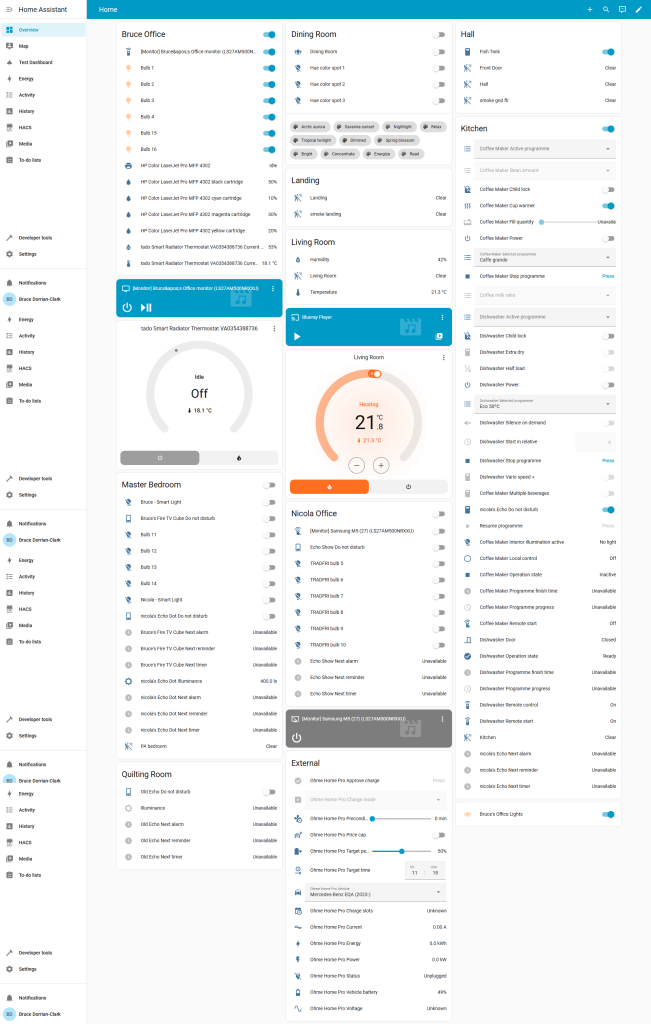
When you first get Home Assistant running, the Overview dashboard feels a bit magical. Devices pop up as if by telepathy: lights, printers, TVs, random “smart” things you didn’t even know were smart. Pretty soon, though, that magic turns into noise. That’s exactly where I’ve found myself: with an Overview that technically works, but is so untidy it’s hard to think straight.
This post is about how I’m starting to tame that mess by using helpers to turn individual bulbs into meaningful “objects,” and why I’ve built a Test Dashboard as a sandbox to experiment with grouping. I’m not claiming this is the best way to do it — but it’s already giving me much-needed clarity.
The Problem: An Overview That Shows Everything
My Overview started as a dumping ground for entities:
- Every individual Hue and IKEA bulb.
- The same bulbs again as “groups” from their native integrations.
- Random devices Home Assistant discovered automatically.
The result was what I think of as bulb soup. In the dining room, for example, I have three Hue bulbs. In the Hue app they behave as a single “Dining Room” group, which is exactly how I think about them. In Home Assistant, though, I ended up with:
- Three individual bulbs.
- One group entity representing the room.
Functionally, nothing is “wrong” — I can control all of them — but the interface is cluttered and confusing. When you see four entries for what, in your head, is just “the dining room light,” something is off.
The Idea: Use Helpers to Model “Real” Things
To fix this, I’ve started leaning on helpers to create entities that match how I actually talk and think about the house.
Instead of three bulbs, I want one thing:
- “Dining Room Lights” as a single controllable object.
The individual bulbs still matter for fine-grained automations, but for day-to-day control, I don’t want to see them. Helpers give me a way to:
- Create logical groups (like “Dining Room Lights,” “Hallway Lights,” “Office Lights”).
- Hide the raw bulbs from the main interface while still keeping them available behind the scenes.
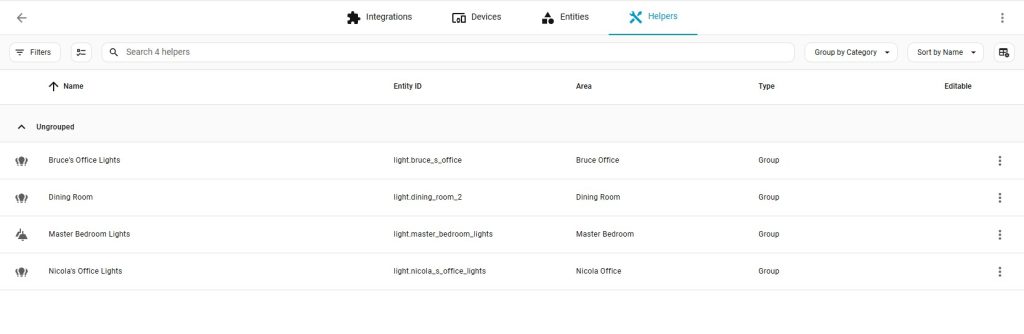
The mindset shift is important: Home Assistant isn’t just discovering devices; I’m using helpers to model the home in a way that reflects how people actually use it.
The Test Dashboard: A Sandbox for Grouping
Rather than experiment directly on the Overview that the rest of the household might rely on, I’ve created a Test Dashboard.
This dashboard is my playground. On it, I:
- Lay out different group entities for the same physical lights.
- Compare how they behave and how they look in various cards.
- Try different naming patterns and icon choices.
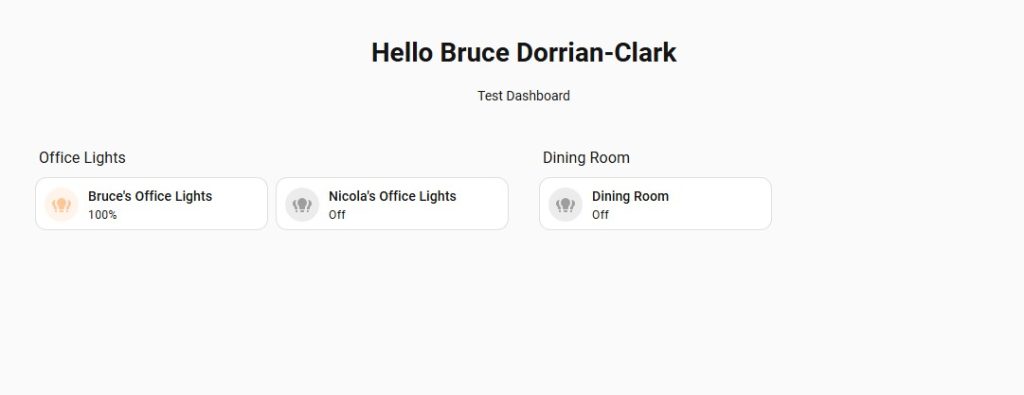
For the dining room case, the Test Dashboard lets me place:
- A tile for the group entity (“Dining Room Lights”).
- The three individual bulbs off to the side.
Seeing them next to each other makes it obvious that, for normal use, only the group needs to be front and centre. The individual bulbs can be hidden from the Overview completely, or tucked away in a more “advanced” dashboard for diagnostics.
This test space has turned into a really useful thinking tool. I can break things, rename things, and restructure groups without worrying about confusing anyone who just wants to turn a light on.
Is This the “Best” Way? Maybe Not — But It’s Better
I’m not pretending this is the final, perfect approach. Home Assistant has plenty of powerful concepts — areas, floors, labels, helpers of various types — and it’s very possible I’ll refactor again once I’ve lived with these changes for a while.
Right now, though, this experiment is already paying off:
- The Overview is starting to reflect rooms and activities, not raw entities.
- I’m getting clearer on naming and grouping conventions as I go.
- The Test Dashboard gives me a low-risk way to evolve the structure over time.
The bigger goal behind all this is simple: I want a home that feels intuitive to control, not a dashboard that impresses people on Reddit. Turning bulb soup into clear, meaningful objects is one small but important step in that direction.